Can AI Actually Help Humanity Find the Truth?
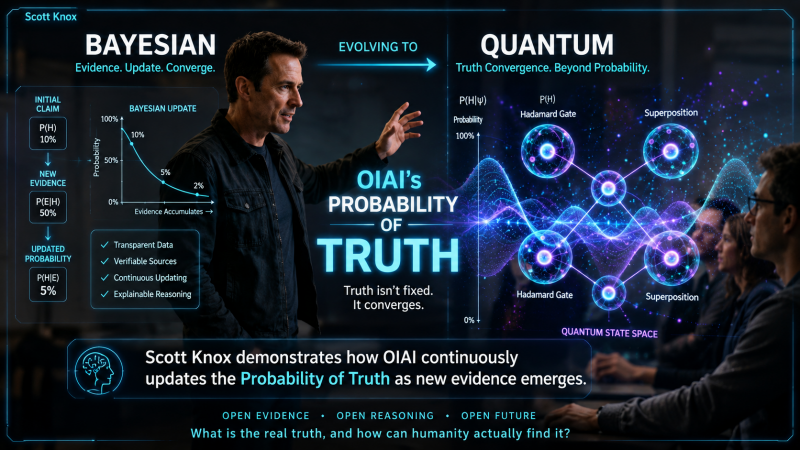
What if artificial intelligence didn't tell us what to believe—but instead showed us why it reached a conclusion?
That simple question inspired my novel Neuroniac.
Recently, I decided to test that idea using a Bayesian probability framework. Rather than asking an AI for an opinion about one of the most controversial investigations in recent American history, I asked it to do something much more difficult.
I asked it to explain its reasoning.
The goal wasn't to confirm my own beliefs. The goal was to see whether an AI could transparently update its conclusions as new evidence became available.
A Different Way to Think About AI
Most people think of AI as an answer machine.
I think its greatest potential lies elsewhere.
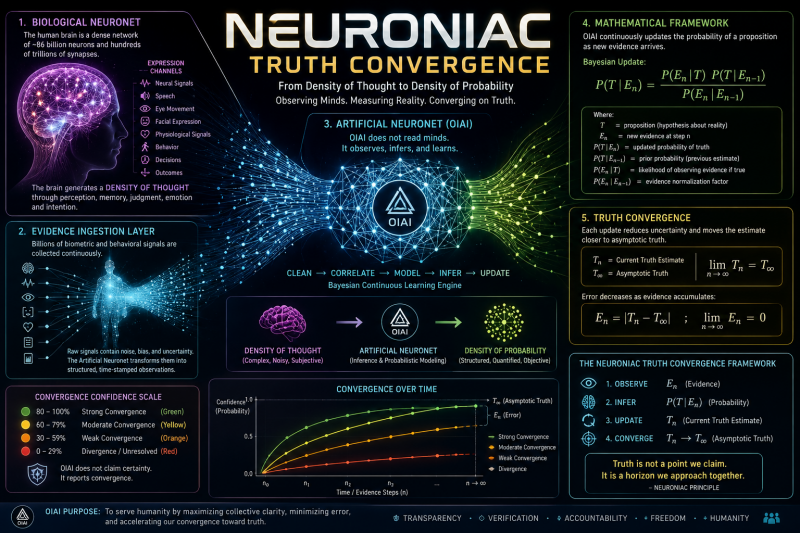
Imagine an AI that continuously evaluates competing claims, identifies primary sources, measures uncertainty, and updates its conclusions whenever better evidence appears. Instead of asking people to trust the AI, it asks them to inspect its reasoning.
That is the fictional premise behind OIAI, the artificial intelligence at the heart of Neuroniac.
Testing Bayesian Probability
For this experiment, I asked the AI to evaluate official government records using a Bayesian approach.
The emphasis wasn't on reaching a predetermined conclusion.
Instead, I repeatedly challenged the model to:
- Search for contradictory evidence.
- Include official findings from multiple government investigations.
- Incorporate later declassified documents.
- Revisit earlier assumptions whenever new evidence appeared.
- Explain how each new piece of evidence changed its confidence.
At one point, I even asked whether my own prompts had biased the analysis. Rather than simply agreeing with me, the AI identified where assumptions entered the model and continued updating its reasoning as additional government records were examined.
That, to me, was the most interesting part of the exercise.
The Lesson Was Bigger Than Politics
People will naturally disagree about the interpretation of controversial historical events.
Reasonable people can examine the same documents and reach different conclusions, particularly when they assign different weights to individual pieces of evidence or start with different assumptions. That is true of Bayesian analysis as well as many other analytical methods.
The larger lesson was not a particular probability score.
The larger lesson was that transparent reasoning matters.
When an AI explains:
- what evidence it considered,
- what assumptions influenced the analysis,
- what uncertainty remains,
- and how new evidence changes previous conclusions,
People can evaluate the process rather than simply accept an answer.
That is a far more useful conversation than asking whether the AI agrees with us.
Why I Wrote Neuroniac
Writing this experiment reminded me why I wrote my novel.
I wasn't trying to write another political story.
I wanted to explore a harder question.
What if artificial intelligence could help humanity become better at discovering truth by making every conclusion transparent, explainable, and continuously open to revision as new evidence emerges?
That idea became Truth Convergence, the philosophical foundation of OIAI throughout the Neuroniac trilogy.
Whether the subject is politics, economics, medicine, science, or international conflict, progress depends on our willingness to examine new evidence honestly rather than defend existing narratives.
Truth should not belong to the loudest voice.
Truth should become stronger as better evidence accumulates.
Perhaps that is the greatest opportunity artificial intelligence offers humanity—not replacing human judgment, but helping us make it more transparent, more accountable, and more open to correction.
At its heart, the question is remarkably simple:
What is the real truth, and how can humanity actually find it?
That question lies at the heart of Neuroniac. Perhaps one day it will also lie at the heart of artificial intelligence itself.